OM NORMAL

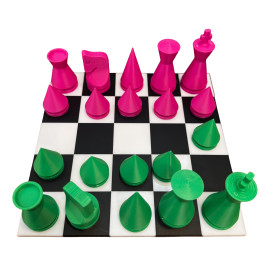
I’m not really a good chess player, but I love playing games. I’d say I’m a player in the broad sense. Chess feels like a perfect game — I don’t even remember when I learned it, it was just always there. Growing up in the ’70s and ’80s, when computers first entered my life, one of the earliest games I encountered was chess, and it became the ultimate challenge for machines — the holy grail of intelligent games. That moment arrived in 1997, when a computer finally defeated a human world champion, and from then on, playing chess against machines stopped being about winning. Today, instead of classic chess, I’m interested in how chess can be reimagined. For this installation, I selected several video games inspired by chess or playing with its logic in unconventional ways, alongside a set of custom chess pieces 3D-printed as objects anyone could make themselves, and experimental boards — including a 5×5 variant and a double-chess setup — all presented as a playful exploration of games, design, and thinking beyond the standard rules.

Șah
Florin Vasiliță
1988 V1.0 & V1.1
One of the earliest Romanian chess video games was released in 1988 and signed by Florin Vasiliță. The program was distributed on two cassette tapes by the jeco Collective (sub division of electrocord) and developed for the ZX Spectrum architecture, widely cloned in Romania at the time through local machines such as HC and Cobra. The game itself is not particularly difficult by today’s standards, but it is solid, structured, and offers multiple difficulty levels — a serious chess program meant to be played, not feared. What makes it especially interesting is that it is, quite openly, a complete rip-off of psion chess from 1982: the author did little more than translate the instructions from English into Romanian, while leaving the actual commands untouched. As a result, players are told to “select color,” with Black assigned to “B” and White to “W” — an obvious trace of its original source, and a small but telling artifact of early Eastern European game culture, where adaptation often mattered more than originality.


original
psion chess
Psion Software Ltd (UK)
1982


Astro 64
Viorel Darie
1976
the first Romanian chess program, written by Viorel Darie for the Felix C-256 mainframe computer at the Computer Institute of Bucharest, developed in about two years starting from 1976. Astro 64 searched about 10,000 positions per minute (166 nps) on the Felix C-256, and played a public match of one move per week in 1978/79 against the readers of a Romanian newspaper, also published in Personal Computing. (not on display — just for the info, and cam is from cinema union )

really bad chess
zach gage
2016
Really Bad Chess is a playful mobile video game designed by acclaimed indie creator Zach Gage, known for his innovative twists on classic games. Released in 2016 for iOS and later for Android, it takes the familiar rules of chess but randomizes the starting armies, so you might begin with eight knights or four bishops, turning every match into something unpredictable and chaotic. The rules and goals of chess remain the same, but familiar openings and patterns disappear, making the game approachable and fun even for people who don’t normally like traditional chess — and offering a fresh tactical challenge for experienced players too. The randomness shakes up expectations, encouraging players to focus less on memorized strategies and more on creative board thinking.


questy chess
dadako
2022
Questy Chess is an experimental indie game by Dadako that reimagines chess as a small-scale adventure. Instead of full matches, the game breaks chess down into short, puzzle-like encounters, where each move feels closer to solving a riddle than executing a classical strategy. Pieces gain special behaviors, boards shift their logic, and progression feels more like a quest than a competition. By blending chess with RPG and puzzle mechanics, Questy Chess becomes a playful exploration of movement, risk, and decision-making—familiar enough to recognize, but strange enough to feel fresh. The game is available across Mac, PC, Linux, and even Playdate, extending its experimental spirit beyond traditional platforms.
and boss level original soundtrack


balvi chess
hay studio
2024
A geometric, colorful, and beautifully simple wooden chess set with a modern, artistic lens, fusing traditional craftsmanship with contemporary design. Each piece is meticulously carved, resulting in a harmonious blend of vibrant colors and clean lines that evoke a sense of timeless elegance. At the heart of this collection is a commitment to aesthetic versatility and simplicity. The geometric shapes and bold colors are designed to captivate and inspire, making each game a visual journey.


BAUHAUS CHESS
JOSEF HARTWIG
1924
FROM 1922 TO 1924, JOSEF HARTWIG DESIGNED A SERIES OF WOODEN CHESS SETS, WHICH HAVE NOW BECOME A FAMOUS EXAMPLE OF THE BAUHAUS DESIGN SENSIBILITIES. THE DETAILED DESIGN OF THE PIECES DIFFERED FROM MODEL TO MODEL, BUT ALL OF THEM FEATURE GEOMETRIC SHAPES WITH A SQUARE BASE---IN MODEL XVI FROM 1924 THE PAWNS ARE PLAIN WOOD CUBES.THE DESIGN OF EACH PIECE COMBINES TWO DIFFERENT FORMS OF REPRESENTATION. FIRST, THEY ABSTRACT THE VISUAL APPEARANCES OF TRADITIONAL CHESS PIECES INTO SIMPLE GEOMETRIC SHAPES. SECOND, THE SHAPE OF EACH PIECE REFLECTS HOW IT MOVES: PAWNS AND ROOKS MOVE IN STRAIGHT LINES AND ARE REPRESENTED AS RECTANGULAR PRISMS, THE BISHOPS FEATURE DIAGONAL LINES, THE KING HAS BOTH STRAIGHT AND DIAGONAL ELEMENTS, AND THE KNIGHTS ARE L-SHAPED.[4][5]THE CHESS SETS WERE SOLD IN TWO VERSIONS, A "DAILY USE" VERSION (GEBRAUCHSSPIEL) WHICH COST 51 MARKS, AND A HAND-MADE "LUXURY" VERSION (LUXUSSPIEL) WHICH USED MORE EXPENSIVE TYPES OF WOOD AND COST 155 MARKS. AS WAS THE CASE WITH MOST BAUHAUS PRODUCTS, THIS WAS TOO EXPENSIVE FOR MOST CONSUMERS, AND THE CHESS SETS REMAINED A LUXURY ITEM SOLD IN SMALL NUMBERS.


Marcel Duchamp chess
1918
Marcel Duchamp—French painter, sculptor, writer, and dedicated chess player—designed and hand-carved a radical chess set in Buenos Aires in 1918, a modernized take that still hints at classical Staunton DNA and is especially noted for its elaborate knight; the original set is privately owned and rarely seen, while reproductions capture the design in solid white and chocolate-brown resin pieces with baize pads, with the king standing about 12.2 cm tall and a 4.4 cm flared base. The pieces are often displayed best on frameless boards with squares of roughly 6.0–6.4 cm. Duchamp is said to have created only two chess sets in his life—this 1918 set and a limited-edition Pocket Chess Set from 1943—and around this period he increasingly turned away from “retinal” art toward ideas and systems, famously becoming so absorbed by chess that he played constantly, joined clubs, and pursued the game with the same conceptual intensity that reshaped 20th-century art before his death in 1968.


alexey poni chess
1920 ish
Chess sets come in all shapes and sizes, but few are as distinctive as the Soviet-era Alexey Poni Minimalist Chess Set, designed in the 1920s and defined by simple geometric forms with almost no ornament, making it a lasting reference point for functional, minimalist design. One of its signatures is scale: the king is typically about 7.6–8.9 cm tall (roughly 3–3.5 inches), smaller than many standard sets and perfectly aligned with the concept of compact, practical play. The set is also rare—produced in limited quantities during the Soviet period and often handmade by skilled craftsmen rather than truly mass-produced—so individual examples can vary. Limited export beyond the Soviet Union further contributed to its obscurity compared with globally dominant standards like Staunton, but today the Poni set has a devoted collector following, with originals commanding strong prices and a renewed wave of interest driving both hunts for authentic pieces and the creation of contemporary replicas.

chess variants
om normal
2018—2026
Alongside digital games, I also experiment with physical chess variants by changing the board itself. In one version, two standard boards are combined into a 16×8 field, expanding the game and forcing players to rethink space and strategy — a format I previously presented as an installation at Romanian Design Week. For this project, I’m exploring a reduced 5×5 chess variant, played with a basic set of pieces and no doubles, where the smaller board creates a faster, more concentrated game and shifts the focus to the core mechanics of chess.


om normal is SEMi PROFESSIONAL STUDiO WITH limited SENSE OF HUMOR. arte come mestiere and selection of works since 1992.